The short version
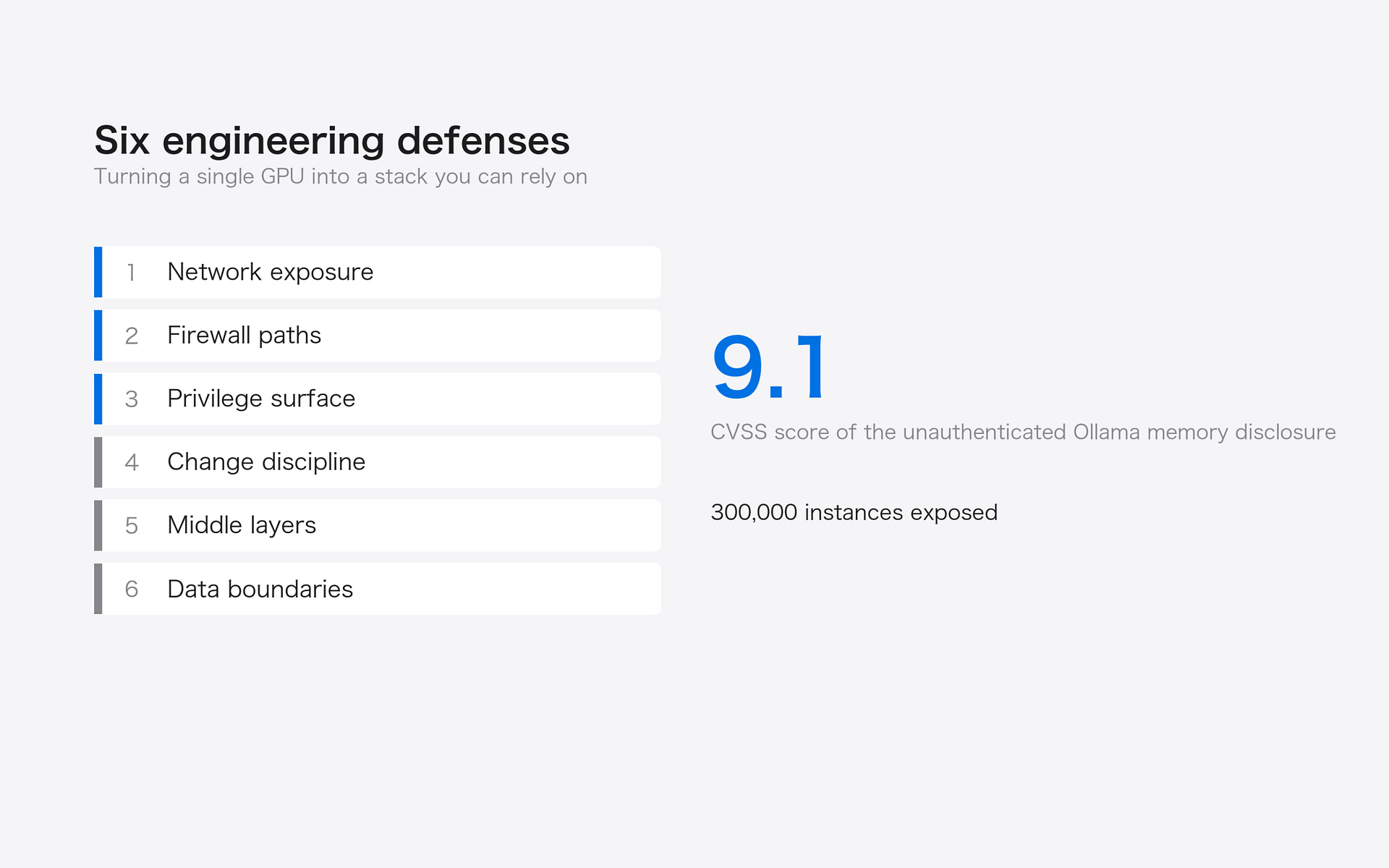
Self-hosted LLM security is nine tenths of the work. Getting a model to answer on a single GPU is the easy part, maybe a tenth of it, and the rest decides whether you can hand that machine real work and leave it running. By the rest I mean the binding, the authentication, the privilege boundaries, the change discipline and the context policy.
The trigger for writing this was a number. A single unauthenticated memory disclosure in Ollama carries a CVSS score of 9.1 and affects roughly 300,000 internet-facing instances. No credentials, three API calls, and an attacker reads the entire inference process memory (CVE-2026-7482, disclosed 4 May 2026, everywhere before Ollama 0.17.1).
A year ago this class of mistake meant somebody else used your GPU. On 12 June 2026, Sysdig’s threat research team documented an attacker using an exposed, unauthenticated Ollama server as the reasoning engine for an automated attack tool. That same month a botnet called NadMesh was found scanning the internet for AI services, and its target list included model servers as well as image generation interfaces, workflow engines and low-code platforms.
What follows is how I took a machine on my own desk from “it runs” to “I let it handle long jobs”, including the night I locked myself out of it. I have stripped the addresses, hostnames and network layout. The judgment calls are the part worth keeping.
Defaults are built for a demo
Local inference tools ship configured so you see a first token within five minutes. Whether the machine is worth buying is a separate cost account I ran earlier. This piece covers what happens after it arrives. That goal sits a long way from serving reliably for thirty days straight.
The bind address is the clearest example. Ollama listens on 11434 by default and ships without authentication. The llama.cpp server listens on 8080, also unauthenticated. It does provide API key options, and most tutorials still hand out a startup command bound to every interface with barely a mention of what that means.
Those defaults are fine on one machine used by one person. They stop being fine the moment you connect the thing to an automation system, and that is where self-hosted LLM security stops being a preference.
My own setup now runs a 27B-class open-weight model as the inference backend for a workflow engine. Getting it to fit at all comes down to the memory budget. It has to wake on command, run overnight batch work, and answer requests from a separate storage server. At that point the bind address is not a configuration detail. It defines your exposure.
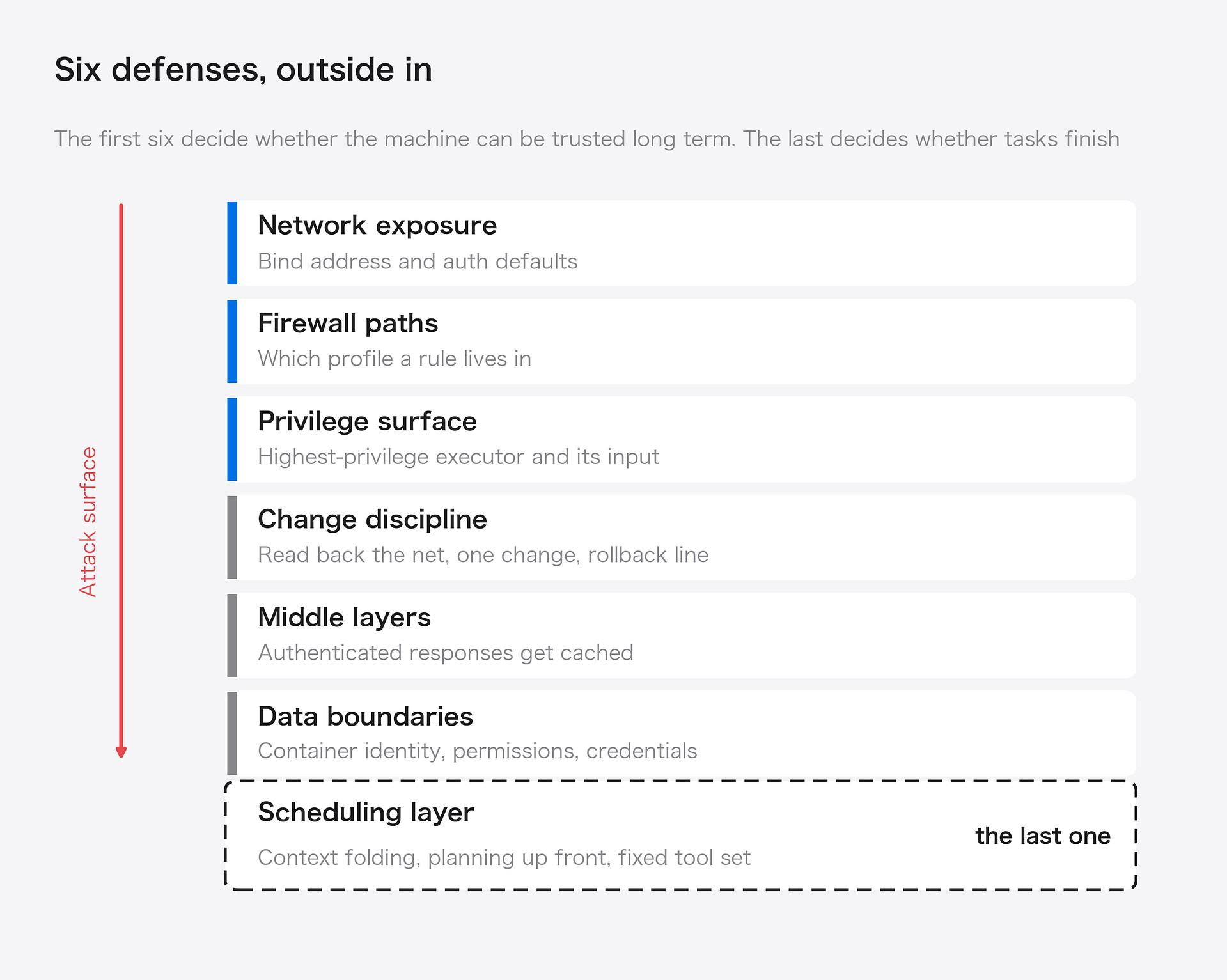
Self-hosted LLM security: six defenses
These are the six places where I hit real problems. They do not substitute for each other, and any one of them failing makes the other five mostly decorative.
Where your server listens, and who can call it
Check where your server actually listens. One command shows whether it is bound to every interface, which means anything that can reach the host can call your model.
On authentication, the llama.cpp server accepts a single API key or reads several from a file. Ollama fixed the memory disclosure in 0.17.1, but the no-auth default did not change, so you put a reverse proxy or gateway in front if you want a credential check.
There is a consequence people miss. With no authentication, anyone who reaches that port gets your hardware and your model working on their data. You have built a free inference pool and you are paying the bill.
A firewall rule that exists is not a rule that applies
This one cost me an evening of confusion. I restricted the inbound rules for the inference ports to my local subnet, which looked clean and complete. The catch was that the machine also joins a private mesh network whose addresses sit in the carrier-grade NAT range, outside that subnet.
Local traffic worked. Traffic over the mesh silently died. No error, no log entry, just a connection that never completed.
Host firewalls are organised into profiles, and the same rule behaves differently depending on which network category the interface carries. When Windows classifies an adapter as public, a rule written only for the private profile is not applied at all. Those categories are separate worlds, and which one a rule lives in determines when it does anything.
The check is straightforward. List every allow rule with its source addresses, its profile, and its port. Then ask which path you actually arrive on and which profile that path belongs to. Any path without a matching rule is dead, and it will not tell you.
There is a subtler trap underneath. When you write a source address as a prefix length, it often reads back as a dotted netmask. A script that asserts on the string it wrote will report the change as failed when the change in fact succeeded. That looks like a check catching a problem. It is a format normalisation.
A job executor running as the highest privilege account is an escalation primitive
On my machine there is a job pattern I designed: a scheduled task running with full system privileges, reading a job file once a minute and performing actions from a whitelist. The point was to let me trigger controlled operations from outside without running a pile of always-on services.
Its safety rests entirely on two things: the action whitelist, and who can write to the directory holding the job file.
If ordinary users can write there, then any low-privilege program that lands on the machine can drop in a job and get one execution as SYSTEM. That is the standard local escalation path and it needs no vulnerability at all.
Whitelists need verifying too, and I got this wrong once. To check whether a scheduled task still existed, I searched the command output for its name. That command fails when the task is absent, and the failure message happens to quote the full command line, which contains the name.
The check always passed. It reported the task present no matter what the machine was doing.
Two fixes came out of it. Read the exit code or a structured field instead of searching output for something you just typed. And give that kind of check a negative control: run the same predicate against an object you know does not qualify, and require it to fail. If the control passes as well, the check is not testing anything.
A safety net you did not read back is not a safety net
Changing firewall settings remotely carries a risk of locking yourself out. The usual practice is to schedule a rollback that restores the previous state after a few minutes, make the change, confirm you can still connect, then cancel the rollback.
That approach is sound, and it saved me. On one occasion the change triggered a network re-evaluation that cut my connection, and the scheduled task restored the configuration.
On a different occasion I made a worse mistake.
I believed the rollback was armed and went ahead with a network category change. Nothing went wrong, but at the end, when I tried to delete the rollback task, the system told me it did not exist. It had never been created. The whole operation had run with no protection at all.
The cause was that I never confirmed it. The creation command produced no output and I read that as normal.
A general rule: the value of a safety net is not that you performed an action, it is that you can currently prove the net is armed. Read it back after arming it, and if the read comes back empty, stop and arm it again. A silently failed safety net is worse than none, because it makes you price the risk as if you were protected.
Authenticated responses get cached in the middle too
This one runs against intuition, which is why it deserves its own entry.
I was doing SEO work on a draft and needed to read the body back for verification. I kept getting an older version while the database clearly held the new one. Eventually I found that an intermediate cache was storing the authenticated API response, despite that response declaring itself private and not cacheable.
The worse part came next. I sent a request to the same address with no credentials at all and received the complete draft.
For that window, anyone who hit that address could read an unpublished article. A draft has no public page. That does not make its contents unreadable.
The order of repair matters. Clear those cache entries first, then verify the fix with an anonymous request, because only a permission denial counts as closed. Do not verify with a credentialed request, since that fills the cache again and reopens the door you just shut. The durable fix is a cache bypass rule for API paths, set at the CDN account level.
Any authenticated read can leave a copy that outsiders can see. Read-only operations still widen your exposure, so when a local tool can query the database directly, skip the network path.
Data landing and container boundaries
The first five layers control who can connect. If you are still choosing hardware, the machine itself is a separate decision that sets what you can run later. This one controls what they can reach once they are in.
Container identity is the usual failure. On my storage server, running a command inside a container defaults to the highest privilege, which means anything mounted from the host is writable. Convenient for one person, a lateral movement path in a multi-component setup.
File permissions repeat the pattern. I had set the knowledge base directory to fully open because several containers write to it. The cost is that anything on that machine can rewrite it.
You can make this concrete. For every component, answer three questions: what identity does it run as, which directories can it write, and do any of those directories hold credentials. If one component can read secrets or overwrite another component’s configuration, that boundary does not exist.
Why long tasks fail: context strategy, not model size
The defenses above keep other people out. This section is about a failure that happens with nobody attacking you.
Once I put a 27B-class local model behind an automated scheduler, the problem I hit most was not stupidity. Around the tenth step it would start repeating work it had already done, forget facts it had confirmed earlier, and treat an intermediate result as the final answer.
The reflex is to buy a bigger model. Two papers moved me off that.
The need for raw input concentrates at the start
The first paper studies multimodal retrieval and analyses roughly 10,000 execution trajectories. It found a clean stage pattern: the moments that require looking at a raw image cluster at the beginning, after which evidence gathering shifts to text retrieval and web visits.
The numbers are sharper than I expected. Of all steps labelled as needing an image, 97.8% fall within the first five. In step one, 95.2% of reasoning text is labelled image-needed. From step two onward that share collapses and derived-from-image becomes the dominant category.
That pattern generalises past images. In most tasks, the moments that genuinely require high-fidelity raw input sit in the initial orientation phase. What the model does afterwards is reason and act, and what it needs then is condensed fact rather than raw payload.
Fold the subtask back into text and drop the payload
Working from that observation, the same paper proposes context folding. A persistent text-only main context handles high-level planning. When raw images are needed, the agent opens an ephemeral branch context, loads the relevant images, completes the subtask, folds the result back as a short text summary, and discards both the images and the branch trace.
Average accuracy improves by 6.3 percentage points while working context length drops 27.5%, from 54.6K to 44.1K on the paper’s baseline.
The ablations carry the more useful lesson, because both extremes are expensive.
Replacing raw images with captions is the worst option, costing 16.3 and 21.4 percentage points depending on the backbone. Substituting a description for the original is not compression, it is loss, and the fine-grained grounding information disappears at the moment of description.
The opposite approach fails too. Keeping raw images resident in the main context throughout costs 6.4 and 7.5 percentage points, dropping back to roughly the level of not folding at all.
Both ends are wrong. The working position is in the middle: load when needed, fold back to text, discard the payload immediately.
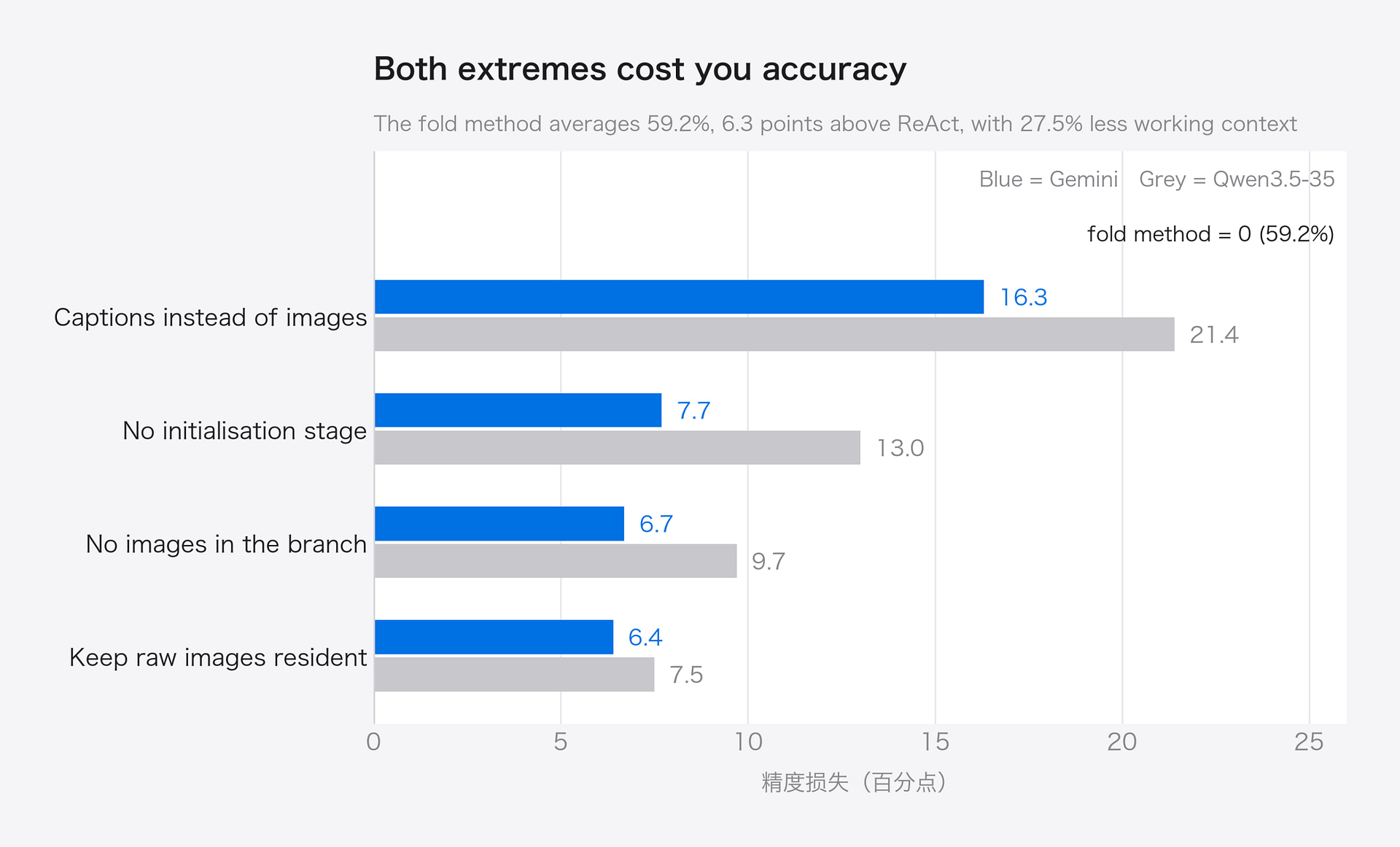
One more piece is easy to skip. Remove the initialisation stage, the pass where the model establishes a visual baseline before starting, and accuracy falls 7.7 to 13.0 percentage points, with the steepest drops on browsing-heavy tasks. The early concentration matters for accuracy as well as frequency. Work done in that phase cannot be recovered later.
A counterintuitive result: recall barely gets used
The second paper studies harness design for coding agents and lays out five context management tiers. One tier makes elided history recoverable: content leaves the context but is stored externally and can be fetched back through a tool call.
That design is appealing on paper, since it appears to deliver both savings and completeness. The measured result is that it is rarely invoked, and accuracy does not improve over elision alone.
This matched behaviour in my own system. My compression leaves a recovery marker, and it is almost never used.
The practical implication is that recall cannot justify keeping a long context around. Your context policy has to assume the model will not go back for what it dropped, which means the facts worth keeping get written into the main context at fold time rather than relied on later.
Planning matters more than parameter count
The same paper has a set of numbers on planning that I keep coming back to.
Without planning, 68.6% of runs terminate having edited no file at all, and 58.4% stop during localisation. With planning, those figures drop to 27.8% and 10.4%. On a smaller model, planning is worth 11.6 percentage points of success rate.
The tool set matters at the same scale. Giving a predefined set raises success by 15.0%, while cutting back to bash only moves the failure point much earlier, with 32.8% of runs ending before a file is ever edited.
What this told me is that when you attach a local model to a scheduler, the first job is a planning stage and a fixed tool set. Choosing a larger model comes after both. The failure mode changes shape, from done-but-wrong to never-started.
What this looks like on a single 27B machine
The main context stays text-only and carries three things: the task goal with current progress, confirmed facts, and the one-line conclusion returned by each folded subtask. Raw tool output never enters the main context. Long intermediate results land on disk and only the path goes into the conclusion.
When something needs a large chunk of source text or an image, it gets its own branch, and only the conclusion comes back.
The full branch trace is discarded.
Every long task opens with a forced planning round that breaks the work into verifiable steps, and the plan itself goes into the main context. That round is a small fraction of the total trajectory, and it determines whether the remaining ninety percent has any direction.
On model size, my current position is that until this structure exists, a larger model mostly buys you a faster way to do the wrong thing.
What this cost
In time, getting self-hosted LLM security right from nothing took a few working days, and half of that went into verification rather than configuration. The configuration is quick. Confirming it actually took effect is slow.
There is an ongoing cost in complexity, and it shows up as things that quietly stop working. After I enabled the firewall, the host stopped answering inbound echo requests, because the default rules allow only messages like destination-unreachable and leave echo requests disabled.
The result was my own monitoring reporting a healthy machine as offline. The fix is an allow rule for echo requests scoped to the local subnet, not from any source.
That example points at a broader cost. Hardening changes a system’s outward observability, and anything downstream that depends on those signals needs adjusting to match. After a hardening pass, run your monitoring and look for new false alarms.
Over-hardening has its own price, since friction in routine operations is what makes people route around the process. The line I draw for myself is to automate the verification wherever I can rather than depend on discipline to hold the state.
Self-check: is your deployment exposed
Check the model server version. Ollama fixed that CVSS 9.1 memory disclosure in 0.17.1, and the version field on the API reports what you are running. Anything older needs upgrading.
Check the listen address. If the server is bound to every interface, answer one question explicitly: which networks will this machine join, and do you trust the devices on them.
Check authentication. If the model endpoint has no key, anyone who reaches the port gets your hardware and your model for their data.
Check the access paths. Match allow rules against the paths you actually arrive on, paying attention to mesh networks and virtual adapters that sit outside your main subnet.
Check the executor directory permissions. Can an ordinary user write to the input directory your privileged executor reads.
Check cache behaviour. Find out whether anything in the chain caches authenticated API responses, and test your own admin endpoint with an anonymous request to see what comes back.
Check how your monitoring decides a service is up. If it relies on echo requests, that signal may already be gone.
Sources
CVE-2026-7482 details and impact. Cyera Research disclosure covering the attack vector and the affected instance population. https://www.cyera.com/research/bleeding-llama-critical-unauthenticated-memory-leak-in-ollama
CVE-2026-7482 patched version and code location. SentinelOne vulnerability entry identifying the out-of-bounds read in the GGUF loader and the 0.17.1 fix. https://www.sentinelone.com/vulnerability-database/cve-2026-7482
LLMjacking incident record. Sysdig threat research, June 2026, documenting an attack using an unauthenticated inference server as its reasoning engine. https://www.sysdig.com/blog/llmjacking-evolved-attackers-are-using-stolen-ai-compute-to-build-offensive-agentic-tools
MM-ContextFold: Context Folding for Multimodal Agentic Retrieval. Source of the folding method, the 97.8% step distribution and the ±6.3 percentage point accuracy comparison. https://arxiv.org/abs/2609.23121
An Empirical Study of Harness Design for Coding Agents. Source of the five context management tiers and the planning and tool-set effects on success rate. https://arxiv.org/abs/2609.20804
What next
I hit each of these defenses by walking into it, including locking myself out once and leaving an unpublished draft readable through a cache. The pitfalls generalise better than the conclusions, which is why they are here.
If you are putting a local model into a production path, or turning a home compute box into something a team can use, tell me what shape yours takes and I will answer against the specific failure points.
Written from public sources and my own testing. For anything version or configuration specific, follow the official documentation.
 Scan with WeChat Pay
 Scan with Alipay
本文采用 CC BY 4.0 许可。欢迎转载与引用,请注明作者并附上原文链接。
Licensed under CC BY 4.0. Quoting and republishing are welcome with attribution and a link back to this article.